Drawing Review, Datums and Fixturing Before the First Cut
Connect drawing review, workholding and inspection before manufacturing begins.
TECHNICAL GUIDE
By Martin Ji, TOVILON Precision ·
An approved prototype carries decisions that never reached the drawing. How to find them, write them down and release them before the first repeat order of a CNC part.
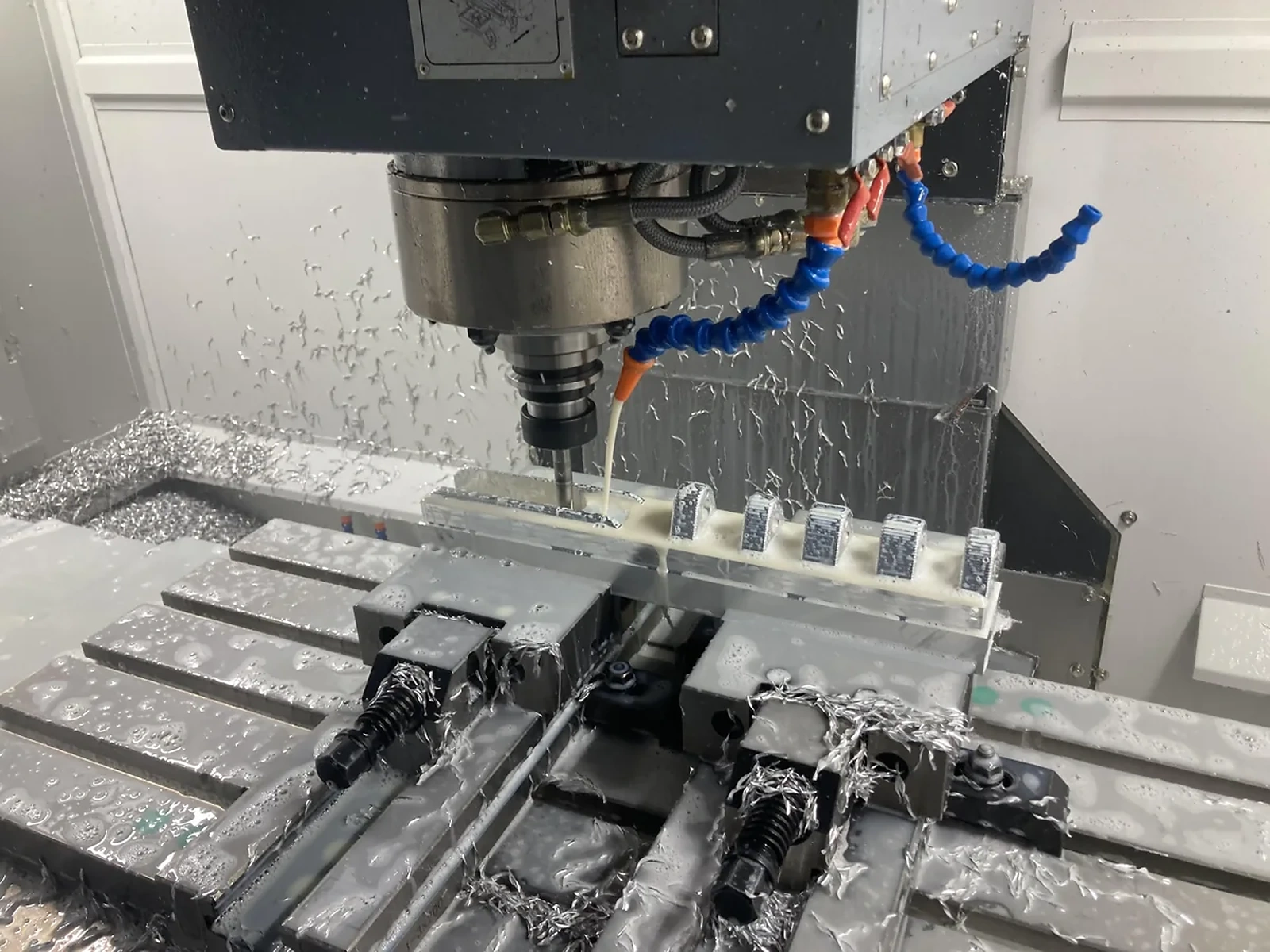
The prototype passed. The assembly works, the test rig ran, and purchasing wants to order fifty. Before that order goes out, ask a plain question: if a different machinist made these parts from the documents alone, would they come out the same?
On a first build the honest answer is often no. A bore was reamed a few microns larger at assembly so the bearing would go in. A hole was opened up by hand. The anodizing was skipped to save a week. None of that is wrong for a prototype. It just has to be written down before it turns into fifty parts, because a production run can only be expected to repeat what is on paper. For OEM teams this is the point where manufacturability stops being a design discussion and becomes a release decision.
Go through the sample item by item and ask where each answer should live once the part is released. The point is to move everything that made the prototype work into a document that the next batch will be made and inspected against.
| Item | Question about the approved sample | Where the answer belongs |
|---|---|---|
| Drawing revision | Were the parts made to the revision being released, or to an earlier one with hand marked changes? | One released drawing revision, matching the CAD model |
| Fits adjusted at assembly | Was any bore, pin or thread reworked to make it fit? | A drawing change, or a recorded deviation |
| Material and temper | Was the sample cut from the specified alloy and temper, or from whatever stock was on hand? | Material line on the drawing, with a certificate supplied for each batch |
| Finish | Was the sample finished as specified, and were the fits measured before or after finishing? | Finish note with coating thickness, masking and whether dimensions apply after finishing |
| Machining sequence | Was the sample made on the same machine and in the same setups that production will use? | The supplier’s route, confirmed by first article inspection on that route |
| Inspection | Which features were actually measured on the sample, and with what method? | An inspection plan that names the method for each critical feature |
| Handling | Were the samples hand carried and wrapped one by one? | A packaging note for faces that must not be marked |
Every difference between the sample and the drawing goes on a single list: what differed, whether it was accepted, and whether it becomes a drawing change or stays a one time concession. A concession accepted for five prototypes should not quietly become the standard for five hundred production parts.
Parts that were fitted on the bench need the most attention. A gripper bracket can work perfectly in the prototype cell because someone shimmed it once during assembly. The deviation record is where that shim gets noticed, before it becomes a missing step on the production line.
A short example of the format. The entries are illustrative.
| No. | Feature | Drawing | Sample | Decision |
|---|---|---|---|---|
| 1 | Bearing bore B2 | ⌀22 H7 | Reamed to the top of the band at assembly | Designer to confirm whether a looser fit is wanted. Until then, the batch is made to H7. |
| 2 | M5 tapped holes | Full thread 10 deep | Full thread 8 deep | 8 deep is enough. Drawing changed at the next revision. |
| 3 | Finish | Type II black anodize | Left bare | Sample not representative. First article is measured after anodizing. |
The order of operations decides when the reference surfaces are cut and whether they survive the operations after them. Finish a precision bore before heavy roughing elsewhere and the bore can move as material comes off and residual stress in the stock redistributes. Thin or asymmetric parts are the most sensitive. For an automation mounting plate, that usually means roughing both sides, letting the plate relax, then finishing the locating face and the hole pattern together in the last setup. Stress relief of the stock is sometimes worth it and sometimes not. It depends on the part, not on a rule.
The trap is a route change between prototype and production. If the prototype was made on a 5-axis machine in one clamping and the batch moves to a 3-axis machine in three setups, the prototype no longer proves anything about the position of features between those setups. More operations do not necessarily make the result more stable. The route should be fixed before release, and changed only with a new first article.
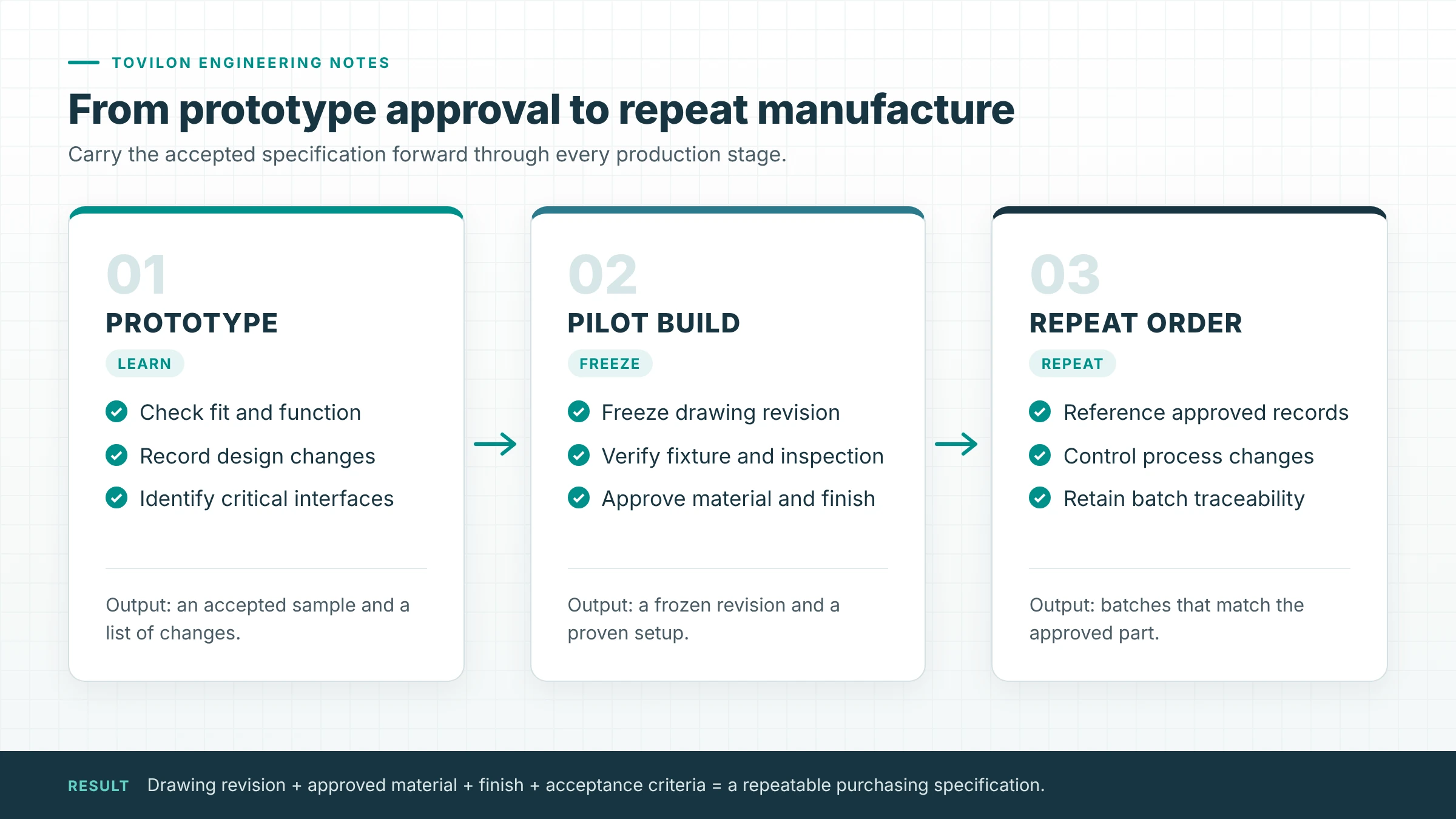
“Aluminum” or “stainless” on a drawing is not a specification. The grade, temper and stock form all change how the part machines and how it moves afterwards.
Substitutions of material or finish should be agreed in writing, not treated as an invisible process change.
The first article inspection that counts is the one made on the production route, not on the prototype. It measures every dimension on the released drawing once, so there is evidence that the route can make the part. After that, repeat batches need a sampling plan for the critical features: how many parts, which features, which method. One accepted sample does not prove every future part.
Measurement conditions belong in the plan too. Temperature, cleanliness, probe access and how the part is aligned can all move a result by a few microns, which matters on an H7 bore. If the prototype was measured with a bore gauge and production is measured on a CMM, agree which method decides acceptance. For how repeat orders stay consistent after release, see batch to batch consistency in CNC machining.
Connect drawing review, workholding and inspection before manufacturing begins.
Compare development, pilot and repeat-order decisions.
Define finish requirements and protected mating surfaces.
When you are ready to release, send the drawing at the revision you want to release, the deviation list from the prototype, and the quantity you expect over the next year. We review the route, the material and the inspection plan against it and send our questions with the quotation. If the prototype was made elsewhere, say so. It changes what the first article has to prove.